Even Japanese people sometimes struggle with the train system in Japan, especially around the Tokyo metropolitan area.
Whenever I pass through Tokyo station, I see travellers standing in front of the giant maps, trying to make sense of them. People often ask me which train goes to their destination, pointing at complicated Kanji characters they can’t read. It’s clear that Kanji can be a real headache for visitors.
So in this post, I’m sharing just TWO simple tips to make your train travel in Japan way easier. And the best part is – you don’t need to understand any Kanji to find your train.
Is Your Train JR or Tokyo Metro? (It Matters More Than You Think)
Are you focusing on your destination name, the train line, or trying to match Kanji characters? If so, you might be wasting precious time during your trip.
The very first thing you should check is which company operates the train you need – usually JR or Tokyo Metro. These are the two major train operators in Tokyo, and knowing which one you’re using is absolutely essential. If you’re unsure, you can easily lose both time and money because their ticket gates are completely separate. I’ve even seen travellers wandering around the JR gates looking for a Tokyo Metro train.
Note
There are other train companies in Japan as well, including Seibu, Tobu, and Toei.
But if you’re visiting the major sightseeing spots in Tokyo, JR and Tokyo Metro will cover almost everything you need. And even if you do end up using another company, don’t stress – just check which operator runs your train and enter the matching ticket gate. It’s the same simple process.
Follow the Colours – It’s the Easiest Way to Navigate Japan
Once you’re through the ticket gate, look for the platform your train departs from.
Sounds easy, right? At a small countryside station, it really is. But once you’re in the heart of a big metropolitan area, things get a lot more complicated. There are so many platforms that it’s easy to get turned around. I’ve seen plenty of travellers get completely lost in this maze of a station – almost like wandering through a Demon Palace.
But here’s the secret: just follow the colours.
In Tokyo’s train system, every major line has its own colour. These colours are instantly recognizable to most Japanese commuters. For example, the Yamanote Line is green, the Sobu Line is yellow, and so on. In the end, you can navigate almost anywhere simply by following the colour signs.
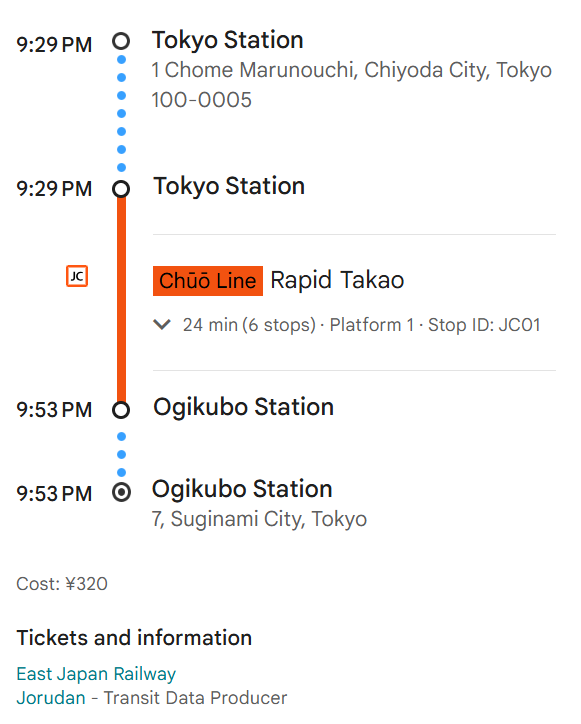
If you’re using Google Maps, the directions will look something like this (see Fig.1). So the real question is: how do you actually find your train?
First, check whether your train is operated by JR or Tokyo Metro. In this example, you can see “East Japan Railway” on the left and bottom of the screen – that tells you it’s a JR train. Next, look for the platform number. In the middle of the screen, it shows “Platform 1,” which is where you’ll need to go.
Just follow the orange signs in the station – they’ll lead you to the right platform far more easily than trying to match the Kanji for “中央線 (= Chuo Line)” on the boards.
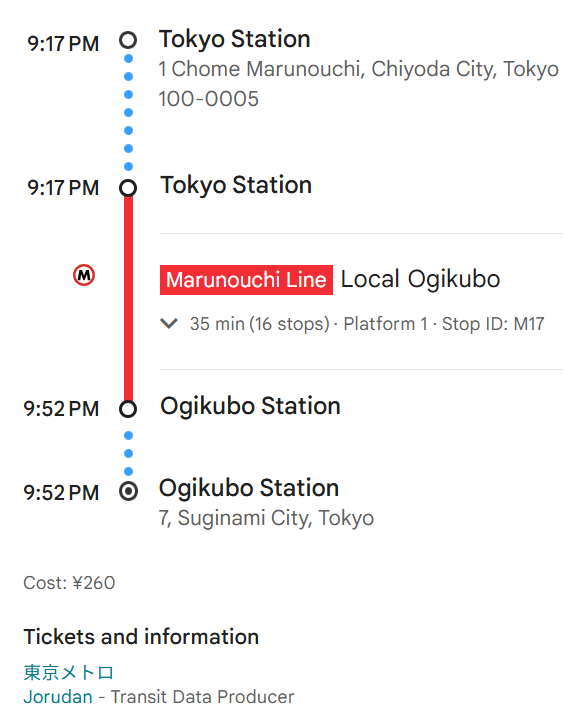
How about another way to Ogikubo station (See Fig2)?
It’s the same process for Tokyo Metro. Just check which company operates the train, and you’ll spot the “東京メトロ” label, which means Tokyo Metro. But don’t have to worry about reading the Kanji – what really matters is recognizing the symbol. Tokyo Metro uses a rounded logo, while JR lines use a square-shaped one.
To sum up, following the colours will make it much easier to find your train. If you’re unsure whether your train is JR or Tokyo Metro, just check the Google Maps directions and look at the symbol. A squared-shaped icon means it’s a JR line, while a rounded one means it’s Tokyo Metro.
And if you’re still having trouble figuring out where to go, don’t hesitate to ask someone nearby. People in Japan are usually more than happy to point you in the right direction.